

Introduction
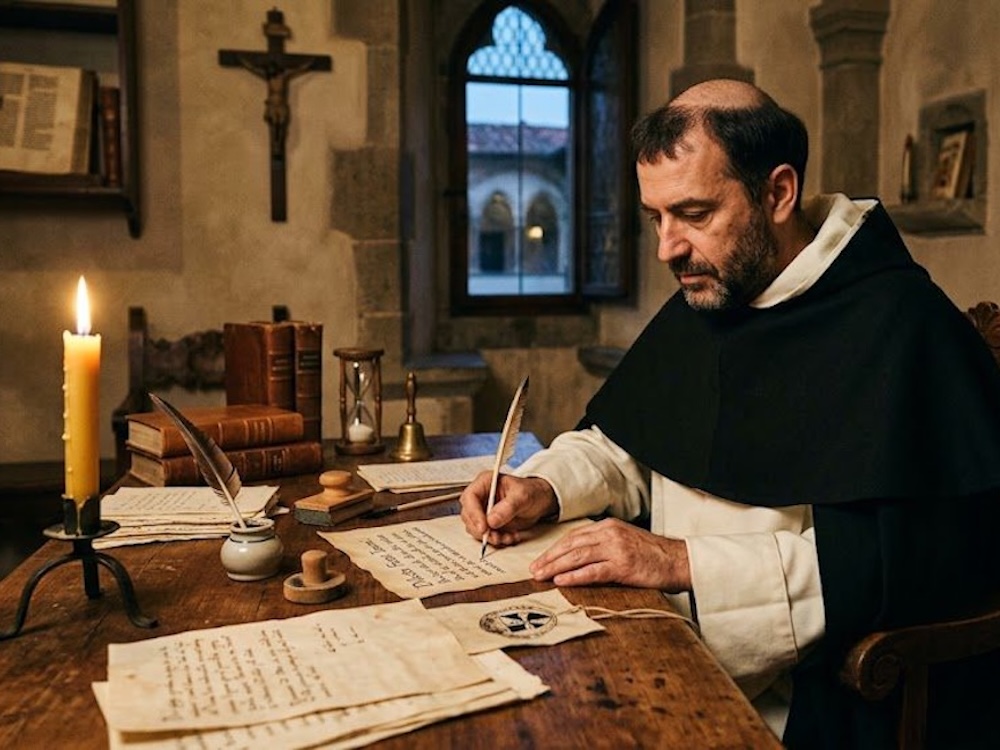
At the beginning of his forward to A. G. Sertillanges’ book The Intellectual Life: Its Spirit, Conditions, Methods, the author makes mention of a letter, believed to be written by St. Thomas Aquinas to “a certain Brother John, in which are enumerated Sixteen Precepts for Acquiring the Treasure of Knowledge.”
Needless to say, that brief reference sent me on a quest for said advice, and I eventually found an original document (pub. 1944) entitled How To Study: Being The Letter of ST Thomas Aquinas To Brother John de Modo Studendi, transcribed from a lecture given by Fr. Victor White, O.P.
However, that document actually lists 12 precepts rather than 16, but seems that upon transcription some of them that were originally stated as one were instead bisected into two, converting the 12 to 15, then it also appears that many are including the last segment of the author’s beginning salutation to Brother John as the first precept, thus making 16 total. So I’ve published that segment in red for easy identification (1.), then listed the next 15 actual precepts listed in the body of the letter (maintaining the prevailing bisections), in close consonance with the original document, which can be read here. I’ve also included some modern interpretations I’ve found online for clarity (in parentheses underneath the text).
And, you can also download the PDF from our Free Ebook Library.

UPDATE 6/16/24: Not only has this article risen to become the #1 most-viewed article on this entire blog, but I also recently read a passage—again in A. G. Sertillanges’ book The Intellectual Life: Its Spirit, Conditions, Methods, which I mention in the introduction—which not only references St. Thomas Aquinas and his precepts for acquiring knowledge, but also the pursuit of Truth—which is one of the core tenets of this blog. So I was compelled to update the article with the new passage:
“In the organization of our life, the essential point to safeguard, in view of which all the rest is necessary, is the wise provision of solitude, exterior and interior. St. Thomas is so deeply convinced of this that of sixteen counsels to the intellectual, he devotes seven to external contacts and to the retired life.”
“The wine-cellar mentioned here [#5]. . .is the secret dwelling-place of truth, of which from afar the perfume attracts the spouse [referring to one who has wed Truth], that is the fervent soul; it is the abode of inspiration, the radiant center of enthusiasm, of genius, of invention, of ardent search; it is the scene of the activity of the mind and its wise delight. To enter into that dwelling, we must give up commonplace things; we must practice retirement, of which the monastic cell is the symbol. “In the cells, and along the great corridors,” writes Paul Adam (Dieu, p. 67), “silence is like a splendid person, clad in the whiteness of the walls, keeping watch.” What does she keep watch over, if not prayer and work?
Therefore, be slow to speak and slow to go to those places where people speak, because in many words the spirit is poured out like water; by your amiability to all, purchase the right really to frequent only a few whose society is profitable; avoid, even with these, the excessive familiarity which drags one down and away from one’s purpose; do not run after news that occupies the mind to no purpose; do no busy yourself with the sayings and doings of the world, that is with such that have no moral or intellectual bearing; avoid useless comings and goings which waste hours and fill the mind with wondering thoughts. These are the conditions of that sacred thing, quiet recollection. Only in this way does one gain access to the royal secrets which are the happiness of the Spouse [again, one who has wed Truth]; only by this mode of living does one hold oneself respectfully face to face with truth.”
And further:
“Children are taught “to give their heart to God”; the intellectual, a child in that respect, must in addition give his heart to Truth; he must remember that he is her servant, repudiate her enemies within himself, love her enemies without, so that they may return to her, and willingly accept the efforts that for the coming day Truth asks of him.”
Check out The Intellectual Life at Compass Bookstore:
UPDATE Aug 2026:
Did St. Thomas Really Write It?
I have since learned that there is a debate concerning whether this letter is authentic, and really written by St. Thomas, for the simple reason that when studying medieval manuscripts, it can be difficult to distinguish between a master’s own pen and the writings of his devoted students. The following De Modo Studendi is no exception. As a result, over the centuries an academic debate has festered over whether St. Thomas Aquinas truly wrote the letter to Brother John, or if it was compiled by a later Dominican follower summarizing the Thomistic philosophy of learning. As a result, many modern text historians classify the letter under the authorship of Ignotus Auctor (Unknown Author) or “Pseudo-Aquinas.”
So I looked into it, and further research has revealed the following evidence, both for and against:
The Manuscript Evidence
If you look at authoritative textual databases, such as the Corpus Thomisticum De Modo Studendi Registry, you will find the letter cataloged among the spuria (false, counterfeit, forged)—or works traditionally attributed to Aquinas but lacking the ironclad historical provenance found in his major treatises like the Summa Theologiae.
The Missing “Brother John”
Historians have never successfully identified who “Brother John” was. On the other hand, in the 13th century, “John” was a highly generic name, so some scholars believe the name was used purely as a literary device—a placeholder name representing any young student embarking on a monastic or academic journey, which is precisely who St. Thomas taught at the Santa Sabina studium provinciale in Rome, where he was assigned to establish a new house of studies (studium), and also where he wrote the first part (Prima Pars) of the Summa Theologiae as an instruction for beginners.
The Thomistic Spirit
The 16 precepts in the letter mirror Aquinas’ known pedagogical style perfectly. His advice to enter the deep ocean by first mastering the small streams directly matches his approach in the Summa Theologiae, where he systematically breaks massive theological mysteries down into small, digestible objections and responses. And again, “John” may well have been a generic name used by Aquinas to represent any of his young students.
Historical Tradition
For centuries, the Dominican Order preserved and utilized this text precisely because it aligned with the methods taught by Aquinas’ own master, Albertus Magnus. Whether written by his hand or transcribed by a student sitting at his feet, it captures the authentic Dominican method of study.
Finally: Does It Even Matter?
Ultimately, the value of the letter remains unchanged by its authenticity or author’s precise identity; in any event it is wise advice. Again, referring back to The Intellectual Life, A. G. Sertillanges addresses this authorship controversy in his foreword:
“This letter, whether it be authentic or not, must be looked at in itself; it is priceless; we should like to imprint its every word in the inmost being of the Christian thinker.” (Although I would contend “of ANY thinker”…)
Note: Due to all the updates interrupting the original the text of this article, I decided to repeat the initial description before readers head into the letter, for clarity:
“…that document actually lists 12 precepts rather than 16, but seems that upon transcription some of them that were originally stated as one were instead bisected into two, converting the 12 to 15, then it also appears that many are including the last segment of the author’s beginning salutation to Brother John as the first precept, thus making 16 total. So I’ve published that segment in red for easy identification (1.), then listed the next 15 actual precepts listed in the body of the letter (maintaining the prevailing bisections), in close consonance with the original document, which can be read here. I’ve also included some modern interpretations I’ve found online for clarity (in parentheses underneath the text).
And, you can also download the PDF from our Free Ebook Library.”
Anyway, I hope you find the following wisdom as insightful as I did:
How To Study: Being The Letter of ST Thomas Aquinas
To Brother John de Modo Studendi
“Brother John, most dear to me in Christ: Since you have asked me how one should set about to acquire the treasure of knowledge, this is my advice to you concerning it: (1.) namely, that you should choose to enter, not straightway into the ocean, but by way of the little streams; for difficult things ought to be reached by way of easy ones.
• (do not read advanced textbooks on day one; master the fundamentals first)
The following, therefore, is my advice to you concerning your way of living:
2. I urge you to hesitate before speaking,
• (avoid small talk, think before speaking, give your carefully chosen words weight)
3. and to hesitate before visiting the common room;
• (avoid places of talk/gossip)
4. Hold fast to the cleanness of your conscience;
• (a guilty conscience can cause mental clutter/distractions, anxiety, and guilt)
5. Do not cease from devoting time to prayer;
• (in modern times this can also mean studies/devotionals, journaling, reflecting, etc.)
6. Love your cell by making constant use of it, if you want to be admitted into the wine-cellar;
• (create a distraction-free study space and use it often, if you wish to be inspired—with the “wine cellar” meaning the domain of wisdom and truth: see Update 6/16/24 above)
7. Show yourself to be lovable to everybody, or at least try to do so;
• (be genial to all, and avoid drama and political debates)
8. but be very familiar with nobody, for too much familiarity breeds contempt and introduces factors which retard study;
• (don’t be overly friendly with others in public, it can breed contempt among your peers, and causes distraction from your work)
9. Also, do not in any way get yourself involved in the doing and sayings of outsiders;
• (avoid altogether those who are toxic, materialistic, narcissistic, heartless, unethical, etc.)
10. Avoid aimless meanderings above all things;
• (avoid random, pointless travels, time-wasting distractions, and idle conversation)
11. Do not fail to follow in the footsteps of saints and of sound men;
• (look to people of proven wisdom, virtue, and integrity for guidance)
12. Do not heed by whom a thing is said, but rather what is said you should commit to your memory;
• (truth is truth regardless of who says it, do not disregard Truth based merely on the source)
13. What you read, set about to understand,
• (do not passively skim over texts; focus, summarize concepts, and build a robust personal knowledge base)
14. verifying what is doubtful;
• (research further any points that you’re unsure of)
15. Strive to put whatever you can in the cupboard of your mind, as though you were wanting to fill a vessel to the brim;
• (remember any and all true and useful knowledge, fill your mind)
16. Seek not the things that are too high for thee.
• (challenge yourself, but avoid setting unrealistic or impossible goals, thereby wasting your time in futile effort and risking burnout)
Follow in the footsteps of that blessed Dominic, who, while he yet had life for his fellow-traveller, brought forth and produced foliage, blossom, fruit—fruit both serviceable and astonishing—in the vineyard of the Lord of Hosts. If you shall have followed these steps, you will be able to attain to whatsoever you have a mind. Fare you well!”
(Again, you can also download the PDF from our Free Ebook Library.)