
In his introduction to the book Einstein on Peace, economist Otto Nathan mentioned that Einstein:
“…had affixed the last signature of his life to a statement of nine scientists, in which the world was warned it would run the risk of universal annihilation unless the institution of war was abolished in the near future.”
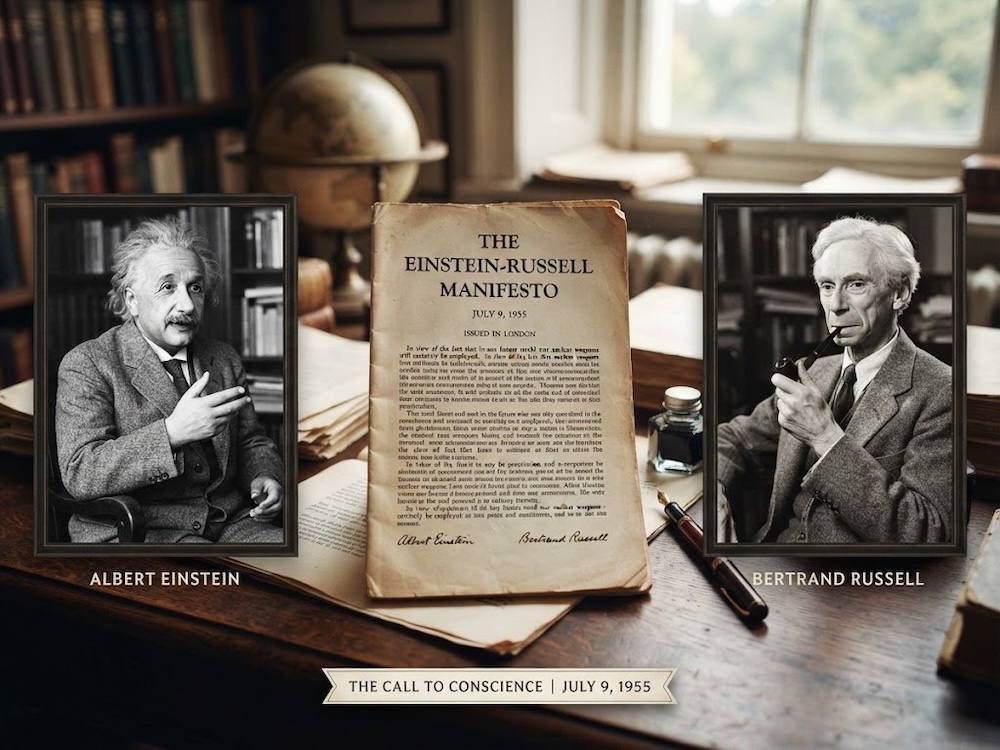
That statement was the Russell-Einstein Manifesto:
“Two of the twentieth century’s most famous intellectuals—philosopher Bertrand Russell and physicist Albert Einstein (who unfortunately passed away a few months before the text was released)—issued the manifesto in London on July 9, 1955 to warn the world about the consequences of a nuclear war.”
And Einstein not only warned the world of the consequences of war involving weapons of mass destruction, but advocated the total abolition of war. According to Otto Nathan:
“Einstein fought for the abolition of war not merely because he hated brutality and considered it unconscionable to seek solutions to international conflicts through killing of human beings; he was convince that, as long as war existed as an accepted institution, the intellectual freedom of the individual—which he considered to be the foundation of human society—could not be realized. The existence of military institutions, the training of youth to serve as unthinking tools for the most flagrantly asocial purposes, the demoralizing effect of war preparations upon civilian life—Einstein considered all this incompatible with the dignity of free men.”
The manifesto concluded with the following resolution:
“We invite this Congress, and through it the scientists of the world and the general public, to subscribe to the following resolution:
In view of the fact that in any future world war nuclear weapons will certainly be employed, and that such weapons threaten the continued existence of mankind, we urge the governments of the world to realize, and to acknowledge publicly, that their purpose cannot be furthered by a world war, and we urge them, consequently, to find peaceful means for the settlement of all matters of dispute between them.”
Signed:
Max Born • Albert Einstein • Leopold Infeld
Herman J. Muller • Linus Pauling • Cecil F. Powell
Joseph Rotblat • Bertrand Russell • Hideki Yukawa
Frederic Joliot-Curie • Percy W. Bridgman
A PDF version of the Russell-Einstein Manifesto can be downloaded from our Free Ebook Library.